Janu Basti Treatment for Knee Joint at Veda5 Ayurveda & Yoga Wellness Retreats in Rishikesh, Kerala & Goa, India
ABSTRACT
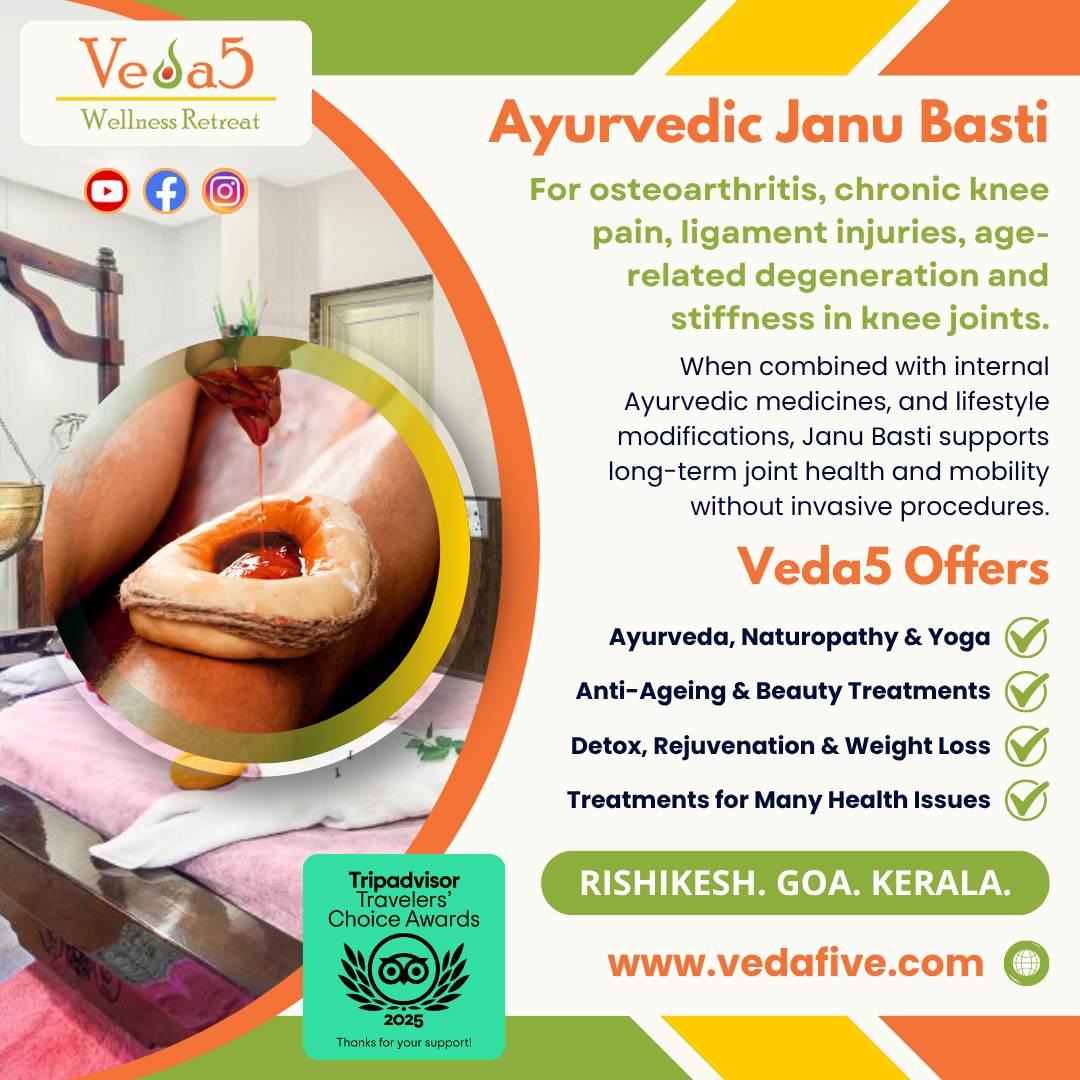
In Ayurveda, this is a specialized procedure that is particularly recommended for Janu Sandhigata Vata. Since Janu Basti is a form of Bahya snehana and Swedana (external oil application and sudation) it can be regarded as Bahirparimarjana chikitsa. On the other hand, some people also think of Janu Basti as Snigdha Sweda. Depending on the condition, different kinds of medicated oils are used in Janu Basti.
INTRODUCTION
Janu Basti is one of the best and most effective Panchkarma therapy that delivers intense relief from painful and inflammatory condition and effectively remedies acute to chronic knee and bone related disorders.
It can also be administrated as a preventive measure to healthy individuals and health enthusiasts to stay healthy and prevent different types of mobility problems and degenerative disorders.
Janu Basti mainly comprises two Sanskrit words; where ‘Janu’ refers to ‘knee joint’ and ‘Basti’ signifies ‘holding’ thus describing the process in which warm oil is poured and pooled for a selective period in a pocket around knee joint using a dough made of wet black gram flour.
The calming, medicated, herbal oil are poured into these formed compartments and left to stay for some time, so that their full benefits can easily seep through the skin into the joint tissues, lubricating them and providing intense comfort, relaxation, and a major reduction in pain and inflammation.
Thus, Janu Basti is an incredible pain relieving, oil pooling therapy primarily conducted for the inflammation of the knee joint and several manifestations associated with it.
MEDICAL INDICATION OF JANU BASTI
The remedial therapy of janu basti can be indicated in the following medical conditions:
-
Osteoarthritis of the knee joint
-
Knee bursitis
-
Arthritis of knee joint
-
Osteoporosis
-
Arthritis changes
-
Ligament tear
-
Post trauma
-
Degenerative disorder of knee joint
-
Subluxation of knee joint
-
Chronic pain of knee joint
CASE STUDY
A female patient, age 31 who has been experiencing pain in her left knee joint for the past two years, came to the outpatient department (OPD). The patient has pain over their knee joint that crackles and makes it difficult for her to walk. The pain gets worse with movement and goes away when she rests.
There is no history of trauma. Her left knee joint’s X-ray shows degenerative changes, a narrow joint space, and some osteophytes. Her left knee joint was diagnosed with osteoarthritis. Examining the left knee joint reveals both audible and palpable joint crepitation during painful joint movement. The patellar tap test results are positive, confirming the visible swelling over the joint. The medial side of the joint was tender, but not inflamed. The patient is instructed to take Janu Basti with Mahanarayanataila after a clinical examination and assessment, and then Dashmoolakwatha Nadi-Swedana.
MATERIAL AND METHOD
For the present study, the following materials are required for each therapy session:
-
Masha (black gram) flour – 1 kg
-
Mahanarayanataila – 500 ml
-
Dashmoolakwath – 2 litres (for Nadiswedana)
-
Spatula – 01
-
Small piece of sponge – 01
-
Water – as per requirement
-
Nadiswedanayantra (Local steam apparatus) – 01
METHODS
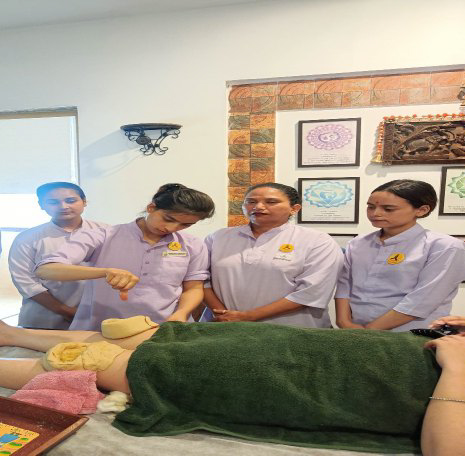
The first step in making Janubasti is to make Mashapisti, or black gram paste, by adding enough water. The patient is then instructed to sit up straight on the table with their knees extended.
The lower limbs receive a mild Abhyanga and the knee joint is appropriately exposed. Then, over the knee joint, Mashapisti is applied as a circular boundary wall that is 4 Angula (roughly 4 inches) high. This is called Basti Yantra, after the circular boundary of Mashapisti is allowed to settle for five to ten minutes.
In the event that the Basti yantra leaks oil, precautions should be taken. Using a tiny piece of sponge, heated Mahanarayanataila is poured into the Basti yantra until it reaches the level of two Angula.
The oil’s temperature should be such that the patient can tolerate it well. Warm oil should be added to the oil to maintain its temperature as it cools down over time. This process takes thirty minutes to complete. Following this, the boundary wall of Masha Pisti is removed and oil is drained from the Basti Yantra.
Nadi Swedana: In this study, the knee joint was treated with mild Abhyanga following Janubasti. The patient is then given Nadiswedana with Dashmoolakwatha over the knee joint. Nadi Swedana lasted for fifteen to twenty minutes.
Therapy schedule: The patient in this case study received two therapy sessions. Six days make up each therapy session, and parameters were assessed both before and after each session. Six days elapsed between each of the two therapy sessions.
RESULTS
Criteria for Assessment – Subjective
| S.No | Subjective Parameter | Before Treatment | After 1st Session | After 2nd Session |
|---|---|---|---|---|
| 1 | Vatapurnadritisparsa | 3 | 2 | 1 |
| 2 | Shotha | 2 | 1 | 0 |
| 3 | Sandhi Shoola | 3 | 1 | 1 |
| 4 | Prasaranakkunchanapravriti | 2 | 1 | 1 |
Criteria for Assessment – Objective
| Objective Criteria | Before Treatment | After Treatment |
|---|---|---|
| Serum Uric Acid | 8.50 mg/dL | 5.83 mg/dL |
DISCUSSION
Several common factors that aggravate Vatadosha include excessive consumption of rich foods, excessive walking or physical activity, direct injury, and suppressing natural urges.
Guna (properties) of Vata such as Ruksha (dry), Shita (cold), Laghu (light), and Chala (movement) also increase from their normal levels in various combinations as Vata becomes vitiated.
To normalize vitiated Vata dosha, it is recommended to use herbs and formulations with opposite Gunas, such as Sneha (oily), Ushna (hot), Guru (heavy), and Sthira (stable).
It is mentioned in the development of Vatav yadhi that aggravated Vata takes up the empty space in the body channels and body parts. According to Acharya Chakrapani, this empty space is simply the location within the body where Guna, such as Sneha, etc. are lacking or absent.
The primary Gunas that are aggravated in Janusandhigata vata are Ruksha (dry) and Shita (cold), which results in Dhatukshya (joint degeneration).
The initiation of treatment protocol, investigations were carried out and it was reported that the level of S. uric acid was significantly lowered.
The patient in this case study initially experiences excruciating joint pain and joint swelling. Janu basti significantly relieves these symptoms after two sessions. Following Janu Basti, there is a decrease in initial audible joint crepitations as well. Joint pain during movement is a very common Janusandhigata vata feature. With two sessions of Janu Basti therapy, there is a marked improvement in this symptom. One of the thirteen Swedana types recommended for the treatment of Vatavyadhi is Nadi Swedana.
According to this study, Nadiswedana with Dashmoolakwath and Janubasti completely relieve joint swelling. Given that the herbs in Dashmoola primarily have Shothahara properties, it might be the result of Dashmoola.
CONCLUSION
Knee osteoarthritis, or Janu Sandhigata Vata, is a very common musculoskeletal condition in the elderly. The primary cause of it is vitiated Vata dosha. There was reduction of complaints as well as improvement in uric acid level (lowering of uric acid) in short period of treatment protocol as well during the follow-up period also.
The case study concludes that the management of Janu Sandhigata Vata can be greatly benefited by Mahanarayana Tail Janu Basti and Dashmoola Kwath Nadi-Swedana.
REFERENCES
-
Lozano R et al. 2012. Disability-adjusted life years (DALYs) for 291 diseases and injuries in 21 regions, 1990–2010: a systematic analysis for the Global Burden of Disease Study 2010. The Lancet 380:2197–2223.
-
Naghavi M et al. 2012. Years lived with disability (YLDs) for 1160 sequelae of 289 diseases and injuries 1990–2010: a systematic analysis for the Global Burden of Disease Study 2010. The Lancet 380:2163–2196.
-
Ackerman I, Fransen M, et al. 2014. The global burden of hip and knee osteoarthritis: estimates from the Global Burden of Disease 2010 study. Annals of the Rheumatic Diseases 73(7):1323–1330.
-
Harrison’s Principle of Internal Medicine, McGraw Hill, 17th edition, p.2158.
-
Charaka Samhita, Chakrapani Commentary, Chikitsasthan, Chapter 28, Vatavyadhi chikitsa, Verse no. 37, Varanasi, Chaukhambha Surbharti Prakashan, p. 618, Reprint 2011.
Veda5 Rishikesh, Goa & Kerala Packages
Please see the Packages menu on our website to learn in detail about Veda5’s well-designed Ayurveda, Panchakarma, Naturopathy and Yoga wellness and vacation retreat and resort packages in Rishikesh, Goa and Kerala, India.
Our guests come from around the world to detox, lose weight, de-stress, rejuvenate, heal and cure many types of illnesses and health issues with the best Ayurveda and Naturopathy doctors and therapists and Yoga teachers in pristine nature, beautiful surroundings, saatvik dining, luxury accommodation, high-quality facilities and world-class hospitality.
Veda5 has been Travelers’ Choice Best of the Best Winner — Tripadvisor’s highest honor for several years.
Click here to send us your booking requirements.
You’re welcome to contact us for more details.
Veda5 looks forward to hosting you soon!
Recommended Posts
Prameha / Diabetes Mellitus: An Integrative Ayurvedic Perspective – Veda5 Ayurveda & Yoga Wellness Retreats in Rishikesh, Kerala & Goa, India
January 31, 2026